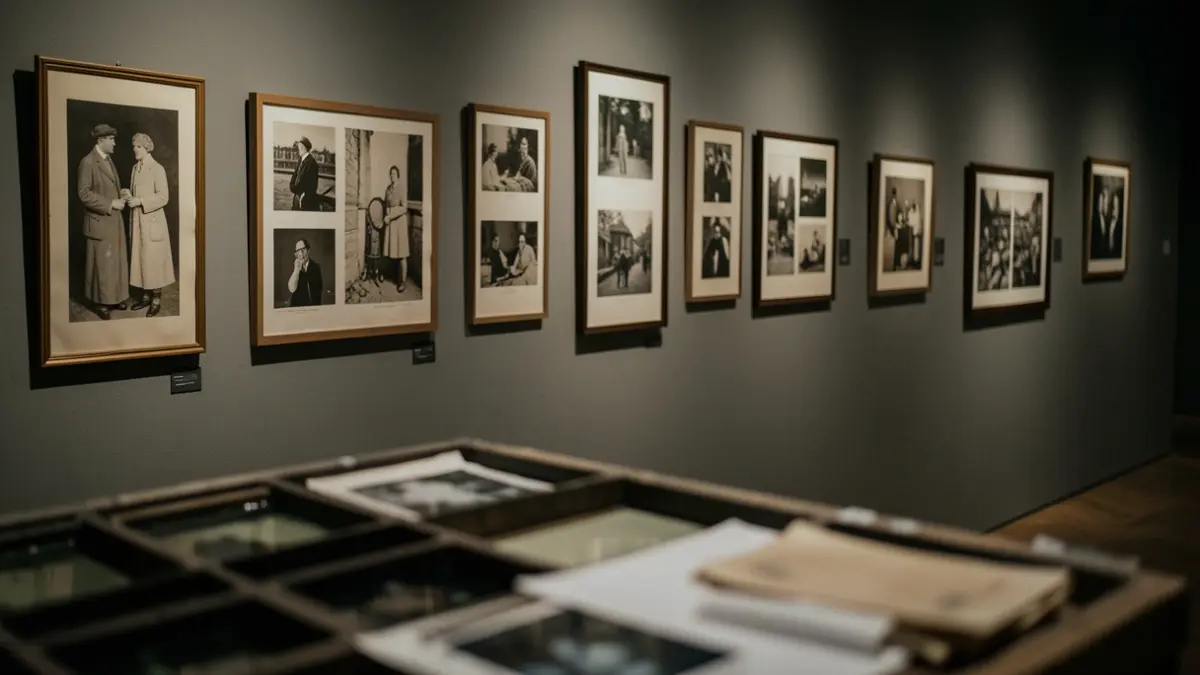
Tate Modern is launching the first significant exhibition dedicated to Pictorialism, a movement that transformed photography into a fine art from the 1880s. This exhibition expands the understanding of Pictorialism beyond its traditional European and North American focus, tracing its global evolution until the 1960s. Featuring 200 rare vintage prints by more than 80 artists from Europe, the Americas, Asia, and Australia, the display highlights the movement's artistic ambition and international scope, presenting a revised history of photography. This initiative aligns with Tate Modern's commitment to re-examining modern art histories from an international perspective.
The exhibition begins by charting the movement's origins in the late 19th century, a period when photographers strived to establish photography as a legitimate art form. It includes works by renowned figures such as French American photographer Adolph de Meyer and American Clarence H. White, alongside lesser-known artists like Chinese photographers Long Chin-san and Luo Bonian, and Indian-born Shapoor N. Bhedwar. These diverse styles, subjects, and techniques illustrate the movement's breadth across different cultural and geographical settings. During this foundational phase, photographers harnessed the expressive potential of the medium, drawing inspiration from painting and other established art traditions. Notable pieces include British photographer Emma Barton's portrait The Awakening (1903) and Long Chin-san's landscape Pavilion Fairyland (c. 1940s), which reflects traditional Chinese ink painting aesthetics.
The second part of the exhibition delves into the art of photographic printmaking, where Pictorialists employed sophisticated techniques and various papers to create unique aesthetic objects. The display will feature pairs of photographs demonstrating the effect of different printing processes, including British photographer Peter Henry Emerson's A Norfolk Boat-Yard (1886). A functioning darkroom will offer visitors insight into the intricate methods of developing and printing. This section also covers the rise of studio photography, with artists using elaborate sets, costumes, and theatrical staging for carefully constructed images. Works by British photographers such as Bertram Park, Yvonne Gregory, and Cavendish Morton are featured, alongside Yevonde's Vivex colour prints from her Goddesses series, showcasing the movement's continuous spirit of experimentation.
A significant section is dedicated to the relationship between Pictorialism and the photographic societies, camera clubs, and salons that fostered its international growth. These networks facilitated the exhibition and publication of work, promoting the exchange of ideas and techniques across borders. Special attention is given to the Royal Photographic Society in London and newly uncovered histories of international clubs like Guangshe in Shanghai, The New Line Group in South Korea, and the Photographic Society of Singapore. Rare books, journals, and magazines from these societies, including publications from Camera Work, Shashinkai: The Monthly Photographic Journal (1920s), and USSR in Construction (1930s), highlight the vibrant print culture through which photographic ideas circulated globally.
The final section re-examines Pictorialism's connection with Modernism. Highlights include works by Sri Lankan photographer Lionel Wendt, such as solarised portraits from the 1930s, and Japanese artist Shigeru Onishi's experimental compositions from the 1950s, which demonstrate the movement's ongoing dialogue with Modernist visual languages. It also traces the evolving practices of leading American modernist photographers Edward Steichen, Paul Strand, and Edward Weston, whose careers spanned both movements. Works such as Steichen’s Primo Carnera (c.1922) and Strand’s Miss Thomson, New Mexico (c. 1922) are displayed. These pieces underscore Pictorialism's lasting legacy and its crucial role in establishing photography as a medium of artistic expression.
The exhibition, Light and Magic, is presented in the Eyal Ofer Galleries. It is supported by Yukiko Ito, the Light and Magic Exhibition Supporters Circle, and the Tate Americas Foundation. Curated by Charmaine Toh, Acting Head of Curatorial, Tate Modern, and Genevieve Barton, Assistant Curator, International Art, the exhibition features generous loans from the V&A.
Tate Members receive unlimited free entry to all Tate exhibitions. Information on becoming a Member is available at tate.org.uk/members. Individuals aged 16-25 can visit all Tate exhibitions for £5 by joining Tate Collective at tate.org.uk/tate-collective.
For press inquiries, contact Joanna Sandler and Perry Stewart via email at Joanna.Sandler@tate.org.uk and Perry.Stewart@tate.org.uk, or by phone at +44(0)20 7887 8730. Press images can be downloaded from Tate’s Dropbox.
Listings information: Light and Magic: The Birth of Art Photography runs from 14 October 2026 to 21 February 2027 at Tate Modern, Bankside, London SE1 9TG. Opening hours are daily from 10:00 to 18:00, with extended hours until 21:00 every Friday and Saturday. Tickets are available at tate.org.uk and +44(0)20 7887 8888. Members enjoy free entry. Follow @Tate #Light&Magic.