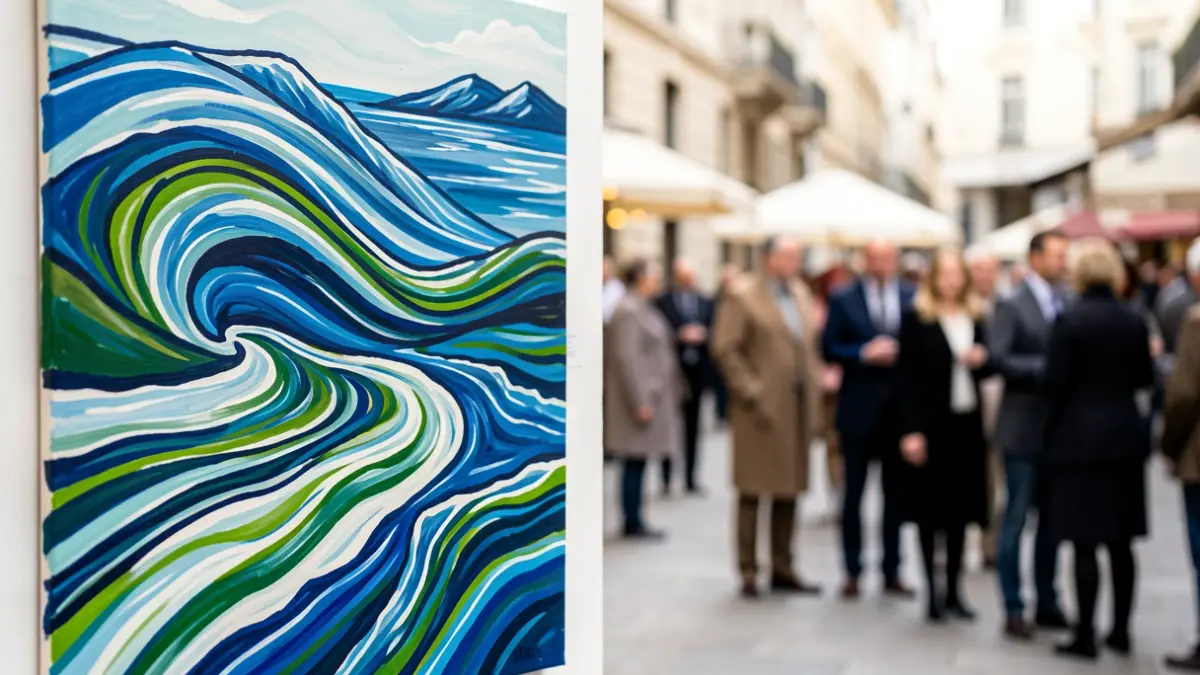
The exhibition, running from 24 October 2026 to 3 May 2027, is the first to encompass the full scope of Barns-Graham’s eight-decade career. It traces her artistic evolution from early landscapes and interiors to increasingly abstract and gestural compositions, highlighting the vitality and range of her remarkable practice. Featuring over 150 paintings, drawings, and prints, alongside archival material and an extensive presentation of her glacier series, the exhibition underscores Barns-Graham’s status as an endlessly inventive artist whose work explores our connection with the natural world and the enduring power of abstraction.
Barns-Graham viewed landscape as a source of sensation, memory, and emotion, acting as a catalyst for her abstraction. Her journey from the Scottish Highlands to the Cornish coast and European terrains informed a distinctive visual language expressing the interplay between inner perception and external reality, termed “looking in / looking out” by the artist.
The exhibition opens with early works from the 1930s and 40s, charting her transition from Scotland to Cornwall. Pieces like Studio Interior (Red Stool), 1945, and The Blue Studio, c.1947-8, demonstrate an early focus on the act of making and the relationship between interior and exterior spaces. Landscapes such as The Episcopal Church, Aviemore, 1938, showcase her engagement with flattened perspective and bold colour. Following her move to St Ives in 1940, Barns-Graham developed a unique response to the Cornish landscape, merging direct observation with memory and sensory experience in works like Box Factory Fire, 1948, and Tregerthen II, 1949.
A pivotal moment occurred in 1949 with her visit to the Grindelwald Glacier in Switzerland. Seeking to convey a “total experience,” she began translating the sensations of ice, light, and movement into dynamic compositions. The exhibition reunites rarely seen loans from public and private collections for the first time in over 70 years, highlighting the Glacier series as a significant turning point in her abstract language.
Barns-Graham’s travels in Italy and the Balearic Islands in the late 1950s further fuelled her abstract exploration. Drawings from these journeys reveal her study of land structures, evolving from observation to abstract compositions. Works created in Cornwall and Leeds, including Rock Theme (St Just), 1953, and White, Black and Yellow (Composition February), 1957, illustrate her continued testing of the relationship between landscape, geometry, and abstraction.
By the early 1960s, Barns-Graham’s work moved towards a more autonomous visual language, exploring dynamic arrangements of circles and squares that reflected on order, disorder, systems, and rhythm, while still evoking natural patterns and broader contexts.
The exhibition also highlights the creative freedom of her later work, as she returned to observing the natural world. Her Small Energy drawings captured wave patterns and wind eddies, while travels to Orkney and Lanzarote inspired new works. In 2001, Barns-Graham stated, “Now I am at the stage of urgency. My theme is celebration of life, joy, the importance of colour, form, space and texture.” The show concludes with exuberant works from her final decades, including the acclaimed Scorpio paintings, showcasing her undiminished creativity into her 90s.
The exhibition is supported by the Wilhelmina Barns-Graham Exhibition Supporters Circle and Tate Members. It is organised by Tate St Ives in collaboration with the Wilhelmina Barns-Graham Trust, curated by Katy Norris and Dara McElligott.
The exhibition will later travel to Pallant House Gallery in Chichester, from 22 May to 31 October 2027. Other current exhibitions at Tate St Ives include Gözde İlkin: Those Who Remember Their Births until 17 January 2027.