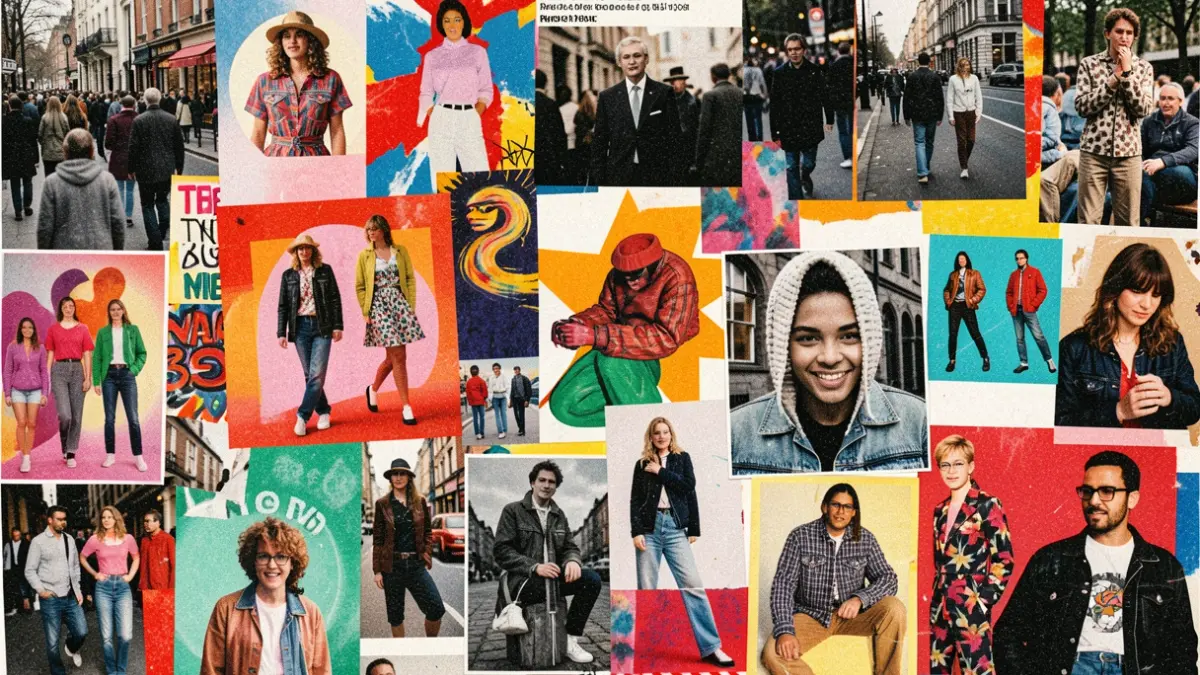
Tate Britain has launched its first exhibition dedicated to the art, photography, and fashion of the 1990s, a decade characterised by possibility and an audacious spirit. Titled 'The 90s: Art and Fashion', the exhibition delves into the period's surge of creative energy, shaped by its unique opportunities and challenges.
Featuring nearly 70 artists, photographers, and designers, including the Young British Artists (YBAs) and Alexander McQueen, the show highlights the emergence of a diverse generation of artistic talent that significantly reshaped Britain’s cultural identity. Drawing on the experience of curator Edward Enninful OBE, the exhibition brings together over 100 photographs, paintings, sculptures, and garments to re-evaluate this transformative moment in British art.
Following the economic uncertainty of the 1980s, the 1990s saw a resourceful new generation of young talent emerge in Britain. The exhibition opens by exploring their 'do-it-yourself' attitude and taste for imperfection, presenting photography by Corinne Day, Nigel Shafran, and Juergen Teller for influential publications like i-D and Dazed and Confused, which defined a new 'anti-fashion' grunge style. The influence of print media is examined through works by Roshini Kempadoo and Eileen Perrier, who expanded mainstream beauty notions. The era saw real people become muses, reflected in the work of Barbara Walker, Jenny Saville, and Gillian Wearing, while artists such as Tracey Emin, Sam Taylor-Johnson, and Sarah Lucas captivated the public with their anarchic spirit and frank explorations of agency, identity, and class.
The decade's youthful attitude is further captured in film and photography focused on nightlife and subculture. Mark Leckey’s 1999 film Fiorucci Made Me Hardcore and images documenting club nights at iconic venues like Manchester's Haçienda and London's Bagley’s are featured. The birth of acid house is documented by Dave Swindells, Peter J Walsh, and Tony Davis, while Normski, Eddie Otchere, and Ewen Spencer cover the rise of jungle, hip-hop, and drum and bass scenes. Joyful queer club nights are depicted by Poulomi Desai, Stuart Linden Rhodes, and Jon Shard. Raves and free parties photographed by Seana Gavin and Vinca Peterson illustrate a hedonistic counterculture, whilst 'Boy Racers' are documented in Elaine Constantine’s series, Burn up Northampton.
The exhibition also explores the decade’s conceptual movements, from body horror to minimalism. Artists like Hamad Butt responded to the AIDS crisis, while Helen Chadwick, Jake and Dinos Chapman, and Cathy de Monchaux engaged with gothic themes. Cerith Wyn Evans, Rachel Whiteread, and Gary Hume experimented with pared-back forms, and Damien Hirst presented fabricated formaldehyde sculptures. Visionary designers such as Alexander McQueen and Hussein Chalayan blurred the lines between art and fashion with provocative presentations and innovative designs. In photography, Nick Knight, David Sims, and Craig McDean embraced starker imagery, whilst Wolfgang Tillmans reflected on technology with Concorde Grid 1997, capturing both optimism and anxiety about the impending millennium.
As the influence of ‘Cool Britannia’ grew, many artists drew attention to those excluded from the narrative. Steve McQueen’s 1993 film Bear, Chris Ofili’s Turner Prize-winning painting No Woman, No Cry 1998 (a tribute to Doreen and Stephen Lawrence), and video by Keith Piper reflecting on sport and national identity are included. The work of Black British designers is celebrated through tailoring by Ozwald Boateng, runway footage of Joe Casely-Hayford’s presentations, and fashion photography by Koto Bolofo, with street style highlighted through a collaboration between Jason Evans and Simon Foxton.
The exhibition concludes by examining artists and designers who reflected on Britain’s past and future at the close of the 20th century. Yinka Shonibare and Maud Sulter drew from European art history, while designers like Vivienne Westwood and John Galliano interrogated style, class, and national mythology. This final section positions the 90s as a pivotal moment between past and future, inviting reflection on the decade's art.
The exhibition 'The 90s: Art and Fashion' is supported by McQueen, with additional support from various Tate entities and patrons. Dazed is the media partner. The exhibition is curated by Edward Enninful, OBE, alongside Tate curators.
The exhibition runs from 8 October 2026 to 14 February 2027 at Tate Britain, Millbank, London SW1P 4RG. It is open daily from 10:00 to 18:00. Tickets are available via tate.org.uk and +44(0)20 7887 8888. Members receive free entry, and those aged 16-25 can join Tate Collective for £5.