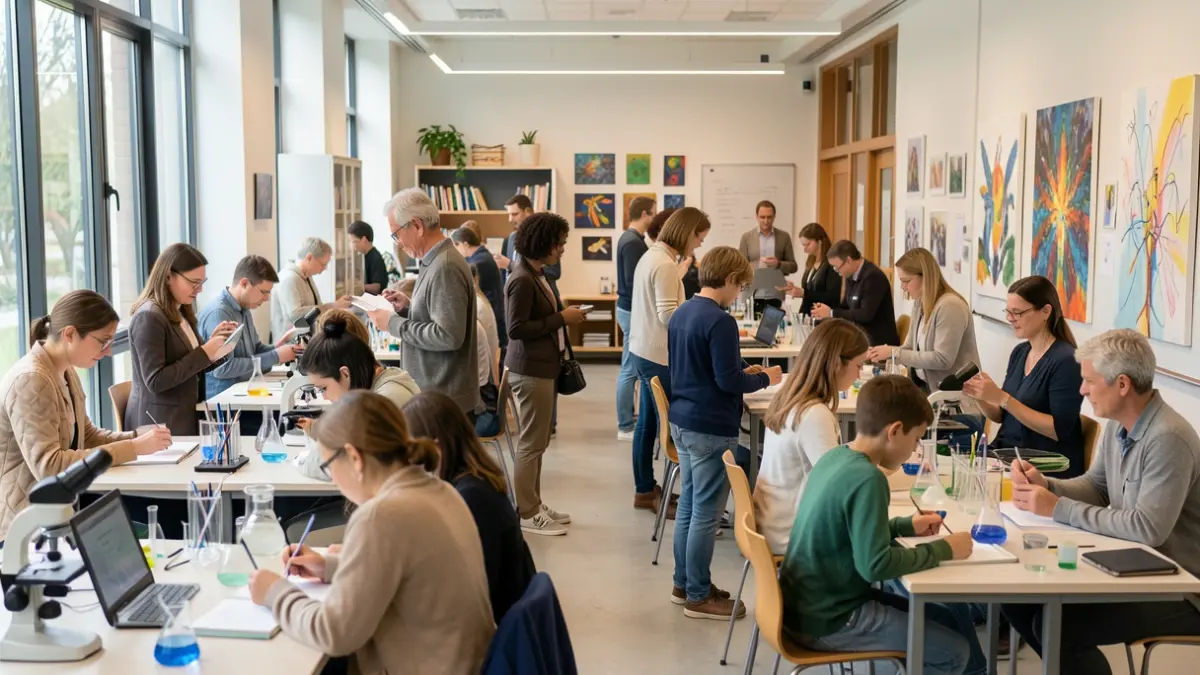

Making healthcare available online does not automatically make it accessible. For migrant communities, barriers can arise at every stage of the journey – from registering with a GP to understanding a referral, trusting a service, or getting the support needed to access care. This was a central message of the recent event, Celebrating World Mental Health Day 2026: Research, Voices & Collaboration, held at The Exchange in Twickenham. The event brought together researchers, healthcare professionals, policymakers, community organisations, and people with lived experience to explore how research and collaboration can lead to meaningful improvements in health and wellbeing. It also marked the launch of a new policy White Paper.
As healthcare services increasingly move online, it is tempting to focus on digital inclusion solely in terms of internet access, devices, or digital skills. While these are important, they represent only part of the picture. Research into digital pathways to primary and mental healthcare for migrant communities in London underscores the need to consider the entire healthcare journey. A service may exist online, but that does not guarantee ease of registration, comprehension of information, navigation of subsequent steps, or access to necessary care.
Language and cultural differences can create significant barriers, as can a lack of trust or uncertainty about data usage. Simply providing a link to a service is insufficient if individuals lack the knowledge or confidence to use it. These are not merely technical issues but fundamental questions about how healthcare services are designed, communicated, and delivered, and whether they truly reflect the experiences of those who need them.
Thought-provoking contributions at the World Mental Health Day event came from individuals reflecting on the realities of accessing and delivering healthcare. A systemic therapist noted that experiences of authority can linger long after arrival in a new country, stating, “a uniform is still a uniform”. For migrants, refugees, and asylum seekers, the uniform of a healthcare professional might evoke associations shaped by past encounters with authority in their home countries. This highlights that building trust requires understanding the experiences individuals bring with them.
The Head of Refugee Services at an organisation (name not provided in source) emphasised that migrant communities are not a homogeneous group. Experiences, circumstances, and support needs can vary significantly, for example, between individuals arriving from Ukraine and those from Afghanistan. Accessible services must recognise these differences rather than assuming a one-size-fits-all approach will suffice.
Discussions also highlighted the burden placed on family members when navigating complex healthcare systems. A postdoctoral researcher and second-generation migrant spoke about the responsibility of translating information and completing forms for her parents, arguing that this burden should not fall on family members by default. Services need to take responsibility for making information understandable and providing appropriate support.
These experiences demonstrate that digital access cannot be measured solely by the existence of a website, online form, or appointment system. Crucially, questions must be asked about who is expected to navigate these systems, what support is available, and whether services acknowledge the circumstances of their users.
Challenges also face professionals striving to improve access. A GP and Professor of Primary Care reflected on how barriers can emerge at every stage of the healthcare journey. Even with positive policy ambitions, financial pressures and limited resources can hinder professionals from delivering the services they intend to provide, risking that good intentions remain on paper rather than translating into meaningful change.
Accessibility requires more than policy commitments; organisations need practical methods to identify barriers, assess resource capabilities, and implement impactful improvements. The White Paper, Availability Is Not Accessibility, offers nine recommendations, including hybrid GP registration by default, support for community-based digital navigation, strengthened multilingual access, and improved communication on confidentiality and entitlements. The accompanying migrant-inclusive digital pathways Toolkit aims to assist GP practices, Talking Therapy services, community organisations, and other stakeholders in assessing their services and identifying practical improvements.
There is no single solution to remove all barriers. Progress depends on organisations understanding where difficulties arise, collaborating with affected communities, and identifying implementable changes. Collaboration is key, with researchers generating evidence, healthcare professionals understanding service delivery realities, community organisations providing relationships and insights, and individuals with lived experience defining meaningful access. Bringing these perspectives together strengthens the basis for change.
The launch of St Mary's Centre for Applied Health and Wellbeing provides an opportunity to strengthen connections between research, policy, professional practice, and communities. The challenges discussed extend beyond digital healthcare, raising broader questions about ensuring services respond to needs, incorporating lived experience into decision-making, and translating evidence into impactful improvements. The central message is that a service's accessibility should be judged not by its existence, but by whether people can actually use it to get the support they need. Digital transformation holds potential for healthcare improvement, but accessibility, trust, and human support must be integral from the outset. To make research impactful, cross-sector collaboration, listening to affected individuals, and translating learning into practical action are essential.
Further resources are available, including accompanying materials, details about the St Mary's Centre for Applied Health and Wellbeing, and collaboration opportunities for staff, students, and external organisations. The university's psychology courses apply social psychology to real-world problems, equipping students with the skills to make an impact in evolving essential service delivery.